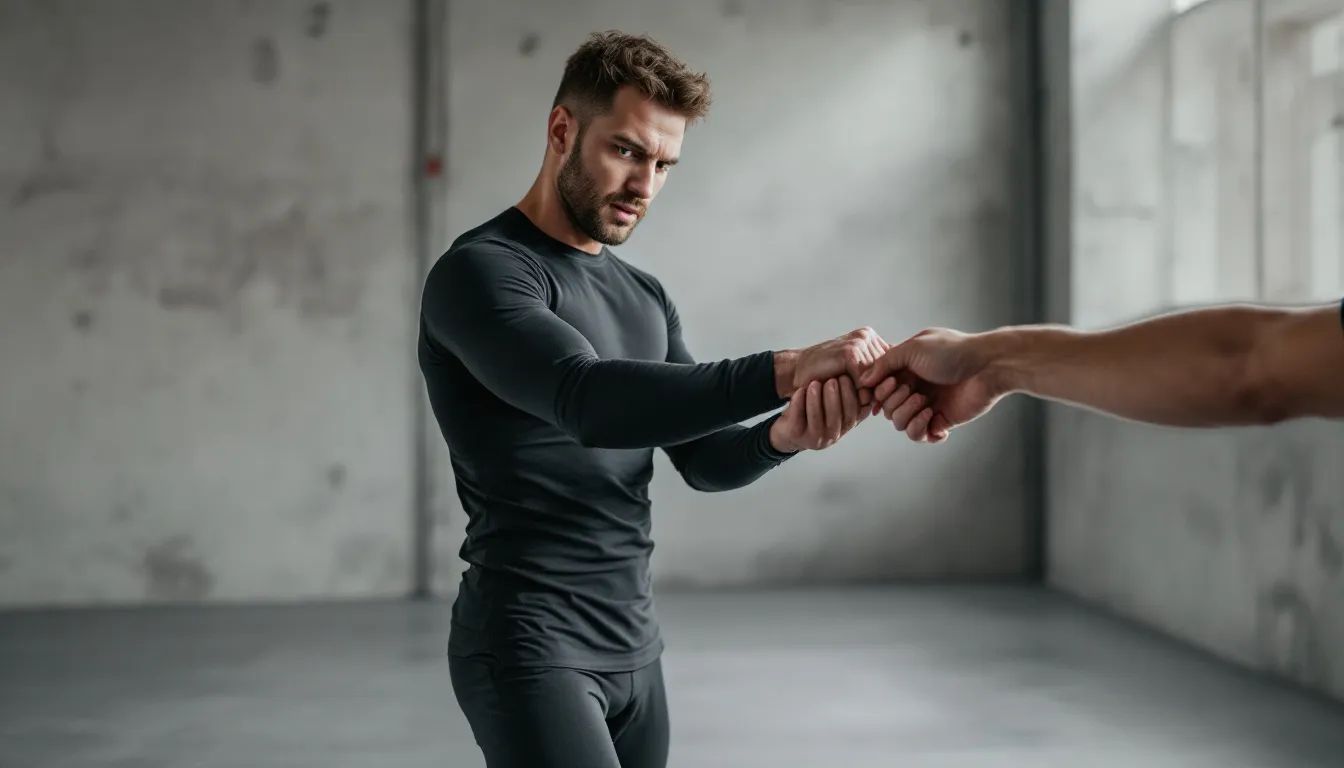
Every school in Singapore describes its training as realistic. The word survives because nobody has to define it, which makes it useless as a claim and quite useful as a test. Realistic has one operational meaning: your partner is allowed to not cooperate. Everything else follows from that.
You can check it in a single session without knowing anything about martial arts. You are not assessing whether the techniques look effective. You are assessing whether anybody in the room is ever allowed to fail.
One test, applied honestly: does the drill have an outcome that is not predetermined? If your partner always ends up where the technique says he should, you are learning a dance with a violent theme.
What is choreography, exactly?
Any drill where the attacker's behaviour is scripted. He grabs with the specified hand, holds still while you work, and falls when the sequence says to fall. That is not fraud, and it is not useless. It is how any physical skill is introduced, because you cannot learn a movement pattern while somebody is genuinely fighting you.
The problem is not that choreography exists. It is that many schools never leave it, and the student cannot tell, because a compliant partner produces a feeling of competence that is indistinguishable from the real thing until the day it matters. Six months of drills that always work will convince you that they always work.
What does pressure-testing actually look like?
It looks less impressive than choreography, which is the first clue. Techniques get uglier, people miss, someone gets stuck and has to abandon a plan halfway. A room doing genuine resistance work is noticeably scrappier than a room doing demonstrations, and the instructors are comfortable with that rather than tidying it away.
| What you see in the room | Choreography | Pressure-tested |
|---|---|---|
| Partner's role | Holds the position and waits | Allowed to resist, adjust, or not let go |
| Outcome of a drill | Known before it starts | Genuinely uncertain |
| When it fails | Rarely, and it gets reset quickly | Often, and the failure gets discussed |
| What it looks like | Clean and impressive | Untidy and a bit awkward |
| What it teaches | That the technique works | Whether it works for you, against someone unwilling |
Why does a compliant partner matter so much?
Because of what happens to you under genuine stress. A 2019 review in Frontiers in Psychology on acute stress physiology and skilled motor performance in policing concluded that skill decay under high acute stress is effectively inevitable, and that it is uneven: gross motor behaviour such as running stays largely intact while anything requiring fine control over muscle tension degrades sharply.
That is the whole argument in one finding. If your training never raises your heart rate or your uncertainty, you have only ever practised in the state you will not be in. The skills you rehearsed calmly are precisely the category that degrades first. Pressure-testing is not machismo. It is the only way to find out which of your techniques survive the transition.
So is a bad class actually worse than none?
It can be, and this is the part that matters more than any technique comparison. Training changes behaviour before it changes capability. Somebody who believes they can handle themselves takes the shortcut through the car park they would otherwise have avoided, and the belief arrived months before the ability. That trade is worked through in why a bad self-defence class is worse than none.
How do I test a class without being difficult about it?
Watch, mostly. Does anybody fail during the hour? When a technique does not work on a partner, does the instructor explain why or repeat the demonstration more emphatically? Is any part of the session unscripted? And ask one plain question afterwards: what happens in your class when the technique does not work. A good answer is specific and slightly uncomfortable. A bad one is that it always works if you do it correctly, which is not an answer about training, it is an answer about faith.
One thing worth saying plainly, since this article is about physical training: the physical layer is the smallest part of staying safe, and the part you should need least often. Most of the value sits earlier, in the field guide to not being a target. A school that spends no time there is telling you something about its priorities too.
Common questions
What is the most realistic self-defence training?
Less a style than a method. The marker is whether drills include genuine, non-compliant resistance, whether outcomes are uncertain, and whether the class spends real time on avoidance and the legal aftermath rather than only on techniques. Those three tell you far more than the name above the door.
Is choreographed training useless?
No. It is how a movement gets introduced, and skipping it would be bad teaching. The failure is never leaving it, because a compliant partner produces a feeling of competence that cannot be distinguished from the real thing until the day it is tested.
Does pressure-testing mean sparring hard every session?
No, and a school that treats it that way is producing injuries rather than skill. Pressure exists on a dial: a partner who simply does not let go, a drill with an unknown starting position, a two-minute round with raised heart rate. What matters is that the dial is turned up sometimes, not that it is pinned.
How soon can I tell whether a school is any good?
One session is usually enough for the compliance question, because you can see whether anyone is allowed to fail. Judging whether the instruction is good takes longer. Judging whether it has changed you takes months.
I am not fit or athletic. Is pressure-testing for me?
Yes, and arguably more so, because you have less margin to rely on. Pressure-testing is not the same as hard sparring. It means finding out what actually works for your body against someone unwilling, which is more useful information the less physically dominant you are.
Pressure testing is the part that is hard to fake and hard to sell. Our classes are built around it.