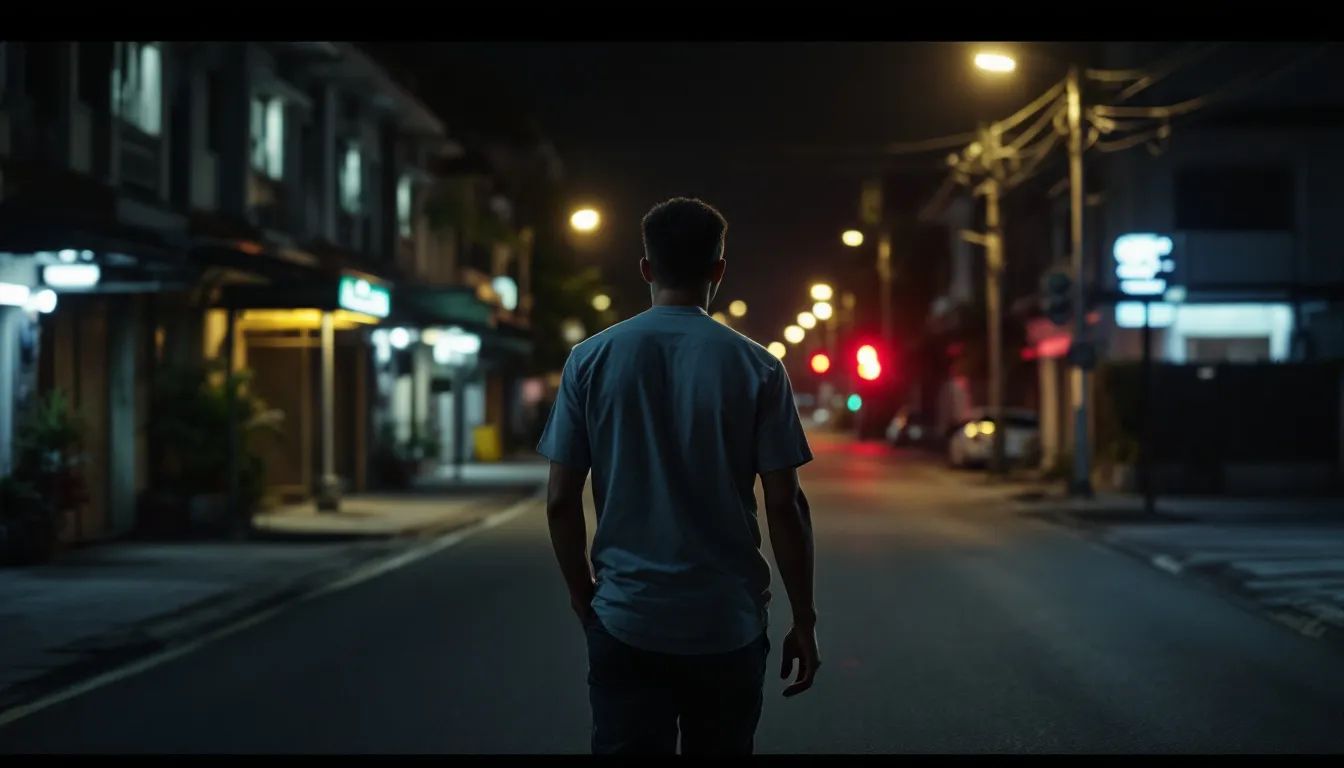
Four hundred metres. That is the stretch between the bus stop and your gate, past the covered walkway where the lights cut out halfway, then along the carpark ramp and the row of shuttered shopfronts. You have walked it more times than you can count, in daylight and in the rain, and never thought about it once. Tonight it is half past midnight, you have been up since six, and you notice yourself walking a little faster than you did this morning.
Nothing has happened, and nothing is especially likely to. You already know Singapore's reputation, and the reputation is earned: this is one of the safest cities on the planet to be out alone at night. But on this one stretch, at this one hour, on the nights you are running on empty, some part of you still picks up the pace anyway. That reaction is not a verdict on the city. It is a signal about you, right now, and it deserves a better answer than dismissing it as paranoia, or telling yourself to just be careful.
I spent eleven years inside the Singapore Police Force, then twenty-two more briefing MNC executives across Asia-Pacific before they landed in cities with real risk. More on that background is on the trainers page. What follows is the honest version of what that experience taught me about nights like this one.
Singapore is genuinely one of the safest places in the world to walk home alone, and the data holds up. Feeling uneasy on one particular stretch, on one particular night, does not contradict that. It is what a tired mind does with a dark, quiet route and very little information to work with. The fix is not more vigilance at 1am, when you have the least of it to spare. It is making the decision earlier, while your judgement is still good.
Is it safe to walk alone at night in Singapore?
Yes, and not by a slim margin. In Gallup's 2025 Global Safety Report, 98% of Singapore residents said they feel safe walking alone at night in their own city, against a worldwide average of 73%. It was the twelfth time Singapore has topped that ranking.
The Singapore Police Force's own numbers point the same direction. Physical crime cases rose 4.4% in 2025, from 19,969 to 20,857, across the whole country. Outrage of modesty, the offence closest to the stranger-in-the-dark scenario people actually picture, rose to 1,531 cases that year, up from 1,427, and more than half of those involved someone the victim already knew. The specific fear behind the 3am walk, being approached by a stranger who has never seen you before, sits inside a small slice of an already small number.
Some of that is structural. Consistent street lighting and a visible police presence make Singapore a genuinely difficult place to commit the kind of opportunistic street crime that drives most fear of walking alone. None of that erases the two numbers above. It is why they are as low as they are.
Why the feeling doesn't match the statistic
None of that makes the feeling on your specific walk wrong. A statistic describes a country. It says nothing about one poorly lit stretch of pavement, at one hour, when you are the only person on it and too tired to reason your way past noticing that. Your unease at 1am is not measuring Singapore's crime rate. It is measuring how much information you have left to work with, and at 1am, on no sleep, there is rarely much left.
That mismatch has a shape. It usually comes from three things landing at once: less light to read the environment with, no one else around to calibrate your reaction against, and a mind that has already spent its sharpest hours on everything that happened before you got to this stretch of pavement. Any one of those alone rarely produces real unease. Stacked together, at the one hour they are most likely to stack, they produce exactly the reaction you are having.
I watched this pattern for years, first inside the police force and then across two decades of corporate security work in Asia-Pacific. The people who got into trouble were almost never the ones who misjudged a genuine threat in front of them. They were the ones making a judgement call at the exact moment they had the least capacity to make one well, exhausted and several decisions past the point where their judgement was still sharp. Singapore's low crime rate does not change that arithmetic. It just means the arithmetic gets tested far less often here than almost anywhere else I have worked.
The four decisions that actually show up on that walk
Most of what gets decided on a late walk home comes down to a handful of small calls, made half-consciously, at the exact hour you are least equipped to make them well. Naming them in advance is most of the work.
| The decision | What it trades away | When it's genuinely fine |
|---|---|---|
| Shortcut through the quiet lot vs. the lit main road | A couple of minutes, for zero witnesses if something goes wrong | The shortcut, when it's still busy and well-lit |
| Empty train carriage vs. the occupied one | Personal space, for no witnesses and no one to signal | The empty carriage, on a bright, watched platform |
| Walking the last stretch vs. waiting for a ride | A few minutes, for a door-to-door option instead | Walking, on a short, lit, familiar stretch |
| Headphones in vs. headphones out | Music or a call, for reaction time and awareness | One ear free, low volume, on a known route |

None of these decisions is inherently right or wrong. What turns one of them into a bad call is making it cold, in the moment, at the one hour your judgement is running on the least fuel it has all day.
This pairs with the three-minute awareness habit we teach before anything else. Most of what makes a route feel safer happens before you have taken a single step on it. The method below is the second half of that same habit, aimed at the one part of the walk a quick scan cannot fix by itself.
Decide in daylight, not at 1am
Here is the method I give students who are otherwise completely fine, and just have one stretch of one route that gets to them. It has three parts, and none of them ask you to be sharper at 1am. That is the whole point. The hard thinking happens earlier, in daylight, while you are actually good at it, so the tired version of you at the end of a long night has nothing left to decide.
Fix the route while you are rested, not while you are tired. Choose your way home on a day you are not exhausted, and treat that choice as settled. It might be the lit road, or the busier carriage. The version of you at 1am does not get a vote on whether tonight is the exception. Most bad calls on a late walk are not bad judgement in the moment. They are a tired mind re-opening a decision that a sharper version of you already made correctly, hours earlier.
Set one rule simple enough to survive being tired. Not a list of things to weigh in the moment, just one line decided in advance. Past midnight, take the lit road. Out after 1am, book a ride, and do not negotiate with the version of you who wants to save ten minutes. A rule like that works precisely because it asks nothing of you except to follow it, not to reason your way back to it from scratch on the one night reasoning is in short supply.
Make the safe option the lazy one. Put the ride-hailing app shortcut on your home screen. Put your most-trusted contact one tap away for sharing your location. If the safe choice takes more effort to find than the risky one, tired-you will take whichever path asks less of you, almost every time. That is not a character flaw. It is just how attention works at the end of a long day.
None of this is about becoming more vigilant, and it is not about assuming the worst of an ordinarily safe city. It is closer to the opposite: deciding once, while your judgement is at its best, so the tired version of you on that one stretch has nothing left to work out.
Common questions
Does feeling uneasy on one walk mean Singapore isn't actually safe?
No. Singapore's safety numbers are real, and one uneasy feeling on one stretch of road does not cancel them out. What you are noticing is a mismatch. Your mind is running on very little information, late and tired, inside a city that is, by any real measure, remarkably safe. Both things are true at once. Treat the unease as a cue to make one small decision, not as proof the city has changed.
Is it worth paying for a ride instead of walking a short distance?
If you decided in advance that you would, yes, without relitigating it on the spot. A short ride costs a small, fixed amount. Standing on a dark stretch trying to decide whether tonight is the exception costs you the clearest thinking of the whole walk, right when you need it most.
Do headphones actually make you less safe at night?
They reduce two things: how early you hear something approaching, and how many seconds you have to react to it. On a familiar, well-lit route that is rarely what decides how a walk goes. On the one stretch that already makes you uneasy, it costs little to go one ear free or turn the volume down, without giving up the walk itself.
What's the one habit that actually helps most?
Deciding the rule before you need it. Choose your route and your ride threshold while you are rested and clear-headed, and treat both as fixed. The version of you at 1am does not have to be braver or more alert. They only have to follow a decision a sharper version of you already made, earlier the same day.
What if something specific feels wrong, not just the walk in general?
That is a different decision, and it deserves its own answer rather than a quick add-on here. If something specific is making you uneasy right now, someone or something you can actually point to, trust it and act immediately. Move toward light and people, and call someone if you need to. Everything above is about ordinary unease on a route you already know, decided ahead of time. A live, specific instinct in the moment overrides all of it.
None of this replaces judgement built through practice, the kind that turns a decision into an instinct instead of an effort. That instinct, choosing well without having to think hard about it, is what we build in the room at JF's programmes.